 Keeping the lights on in Aotearoa is highly skilled work carried out by thousands of lines workers across the country. These workers build and maintain the electricity distribution networks that bring power from the national grid to our homes, businesses, and essential services. Their work includes maintaining poles and wires, responding to outages, upgrading ageing infrastructure, and restoring supply after storms and natural disasters. It is complex, often hazardous work that calls for real expertise and teamwork. As Aotearoa moves toward a low-carbon future, demand for electrical trades is expected to grow even further, with new investment in generation, storage, and distribution requiring more skilled workers than ever before.
E tū members work at Transfield, Northpower, Downer EDI Engineering, Tenix, the New Zealand Transport Agency, Contact Energy, Omexom, and many other employers large and small. Electricity distribution is delivered through a mix of ownership models. Many networks are owned by consumer trusts, while others are council controlled or privately owned companies. Across all these models, lines workers play the same vital role in keeping communities powered and safe.
E tū has a long history in this industry and our strong organising presence means excellent union density on worksites. That strength has delivered very good pay and conditions over many decades, with solid collective agreements that reflect the skill and responsibility required in the job. Members are deeply proud of the work they do, and the standards they have helped to set for the wider industry.
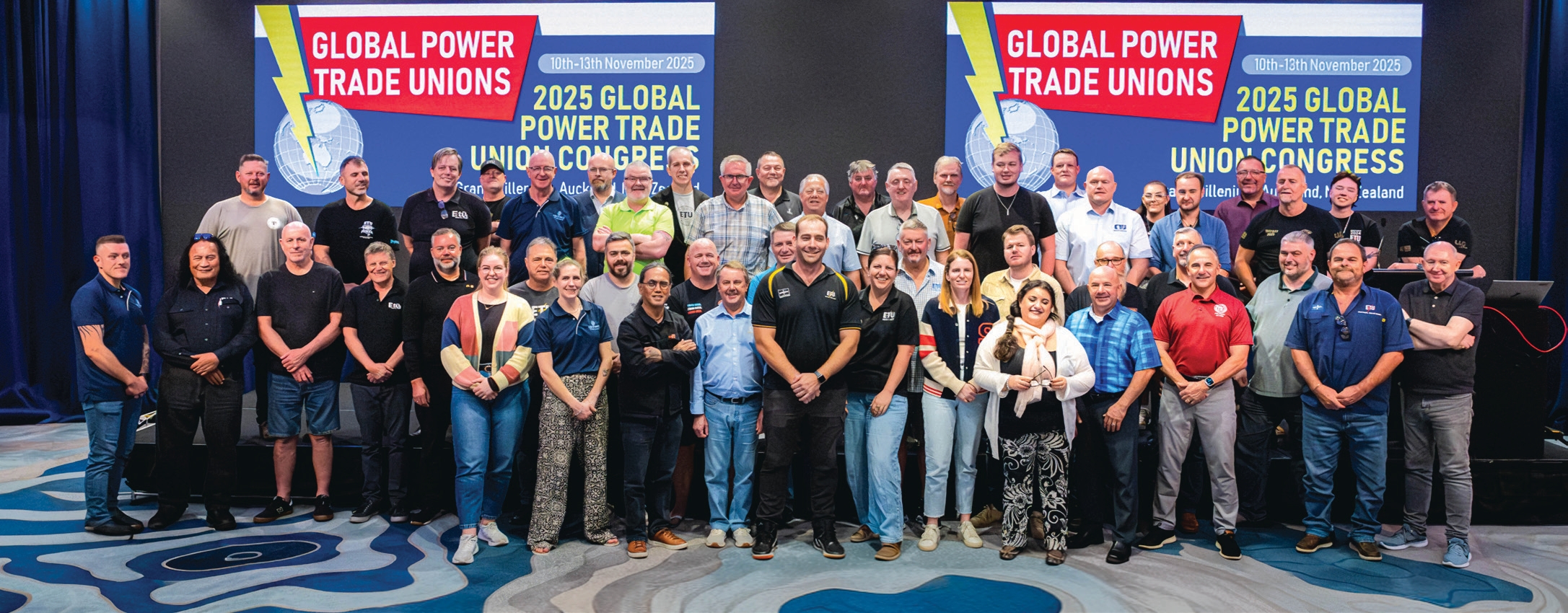
An E tū delegation attended the Global Power Trade Union Congress in Auckland, which brought together unions from across the world to share experiences and plan for the future of the power industry. Delegates discussed the growing international demand for electricians and lines workers as countries transition to greener energy systems. Other unions also showcased highly organised approaches to training, health and safety, and political advocacy. Their work underlined the importance of strong networks and “earn while you learn” apprenticeship pathways, as well as tackling barriers such as high housing costs that affect workers everywhere.
Health and safety was a major theme, including concerns about asbestos and silica in imported components used in wind farms. Delegates also heard a sobering account of how power privatisation in 2014 contributed to major industry closures a decade later. Our representatives returned with a renewed focus on building union strength, lifting apprenticeship recruitment, and promoting the benefits of union-negotiated protections such as insurance cover. E tū will continue to work with international partners, because the issues workers face, and the companies we deal with, are shared not just nationally but across the globe.
Ray Pilley
Lines electrician,
E tū Communications Industry Council memberI’m an electrician for Delta on the Aurora network, doing planned maintenance and new installation work. Aurora owns the network in Dunedin and part of Central Otago, and Delta also has contracts in Tasman and electricians around the country doing revenue meter replacements. It’s varied work and we’ve got a great group of people. If you want overtime there’s usually plenty, and we’re one of the few companies that still has double time in the agreement. There’s also good money to be made doing out-of-town work, with really decent allowances. That’s thanks to having a strong union.
“The challenges are keeping a steady workflow from the asset owner, because it can go flat out, then go quiet, then flat out again. The other big one is the shortage of skilled tradespeople. The industry needs to be growing more apprentices. Our company even had to bring in linesmen from the Philippines because we just couldn’t get enough people here. It’s great to have them, and they’ve all signed up to the union, but it’s expensive to bring them over. There’s a lot of poaching between companies, with sign-on incentives and people moving back and forth.
“It’s a great opportunity for young New Zealanders, and we need to be promoting that in schools. At the recent Global Power Trades Union Congress, it was also clear we need more women in the industry. The workload ahead is huge and we won’t meet it unless we broaden who’s coming through.”
Bargaining snapshot
Across the lines industry, bargaining continues at pace as members work to protect strong conditions and lift standards further. Recent rounds show clear expectations on pay, employer contributions to KiwiSaver, and important protections such as life cover and income protection insurance.
At Ventia Electricity, members are now considering an offer of 3.9 percent followed by 3.4 percent. Ventia has also confirmed it will move ahead of new KiwiSaver requirements by matching employee contributions up to 4.5 percent from next year. This follows the lead of smaller companies such as Counties Energy, which introduced a 4 percent employer contribution earlier in the year.
Bargaining at Downer Electricity is underway and we are waiting for a formal offer. A key goal for members is securing E tū – only life cover and income protection insurance. If achieved, Downer, Ventia, and Northpower would all have these protections in place.
At Omexom, bargaining has just begun for the agreement expiring on 31 December. Membership in Wellington has increased, with former Northpower members shifting across when the Wellington contract changed hands. They are determined to lift Omexom’s conditions to match the standard they previously enjoyed.
At Northpower, the collective agreement runs until 31 May 2026. The focus for now is on building strength at worksites, recruiting new delegates, and making sure members have strong representation ahead of the next bargaining round.