
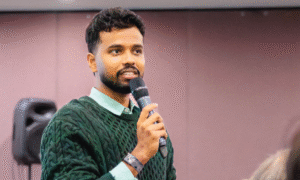
For this issue we talked with Vicky Gajalakshmi, a caregiver and E tū delegate at an aged care home in Hamilton. He moved here from India in 2023, and it was not long before his workmates voted him in to represent them.
Tell us about moving to New Zealand and getting into your job.
It was completely out of the blue. I did my bachelor’s in visual communication back in Chennai, in Tamil Nadu, India. During the Covid lockdown I did an NZQA Level 3 caregiving course from India, because the borders were closed and New Zealand was letting students study from overseas. After a year I had the chance to come over, finish my clinical hours, and get my certifications.
Getting a job was hard. I went to more than 30 interviews and failed nearly all of them. I finally got in with the group I work for now, and I am grateful to this day to the manager who hired me. He kept faith in me. I do not know what he saw, but it changed everything. I came over in 2023, and it has been a grateful ride ever since.
How did you get involved in the union?
To be honest, the union chose me. I did not choose the union. A colleague encouraged me to join, and within a few months my fellow members voted for me to become a delegate. It started from there, and I slowly began to learn. What is pay equity? What is bargaining? What does this sector actually do for elderly people, and how far behind are we for the work we do and the pay we get?
Now I see myself as a bridge. I connect migrant workers with the aged care system, where a lot of people do not know what is really happening, or how undervalued their work is. That is what I feel I am doing, standing between migrant workers and the policies that shape this sector.
What do you think is important in aged care right now?
The most important thing is to be honest about the work we do. Proper care takes time. One shower can take 25 to 30 minutes for a single resident. A two-person assist takes longer. A hoist takes longer again. That is what it takes to do right by a person.
The problem is the system is not built around that reality. The time we are given, and the staffing on the floor, assume the work can be done far faster than it ever can. “Short-staffed” has become just a word. It is treated as a normal part of how the sector runs, rather than a problem the system has to fix. The people who wear that are the residents and the workers.
So my message to other members is to speak up about how much this work matters and what doing it properly really takes. Do not let the system pretend the time is there when it is not. Show what good care actually involves, for every single resident, and make that reality impossible to ignore. If you honestly count what each person needs, the answer is always the same. You need enough staff, and enough time, to care for people the way they deserve. That is what we should be standing up for.
What do you get up to outside of work?
That is wide and deep! I am really curious about artificial intelligence. I study the latest trends, pay for the tools, and practise with them, including the big language models. I make video and audio avatars, even cloning my own voice and image so it can play back like me. I also read a lot about politics, especially geopolitics and diplomacy.
All of that came after I joined the union, especially after my first year of bargaining. My organiser was a huge support and got me interested in politics. I do it through my own reading, YouTube, and books, nothing formal, though I do study AI through online certification courses. On top of that, I have just completed my Careerforce assessor registration, so I now mark Level 2, 3, and 4 papers and dementia papers as a registered assessor.